
3Q 2026 Review and Outlook
U.S. equity markets posted more modest gains in the third quarter following their sharp second quarter advance. The S&P 500 recorded a 2.3% total return as strong corporate earnings and continued enthusiasm surrounding investment in super intelligence (SI), formerly known as artificial intelligence (AI), were partially offset by a meaningful rise in interest rates.
Fixed income markets came under pressure as Treasury yields moved higher, particularly late in the quarter. The Bloomberg U.S. Aggregate Bond Index declined approximately 3.5%, illustrating the inverse relationship between bond prices and rates. Higher yields and a stronger U.S. dollar also created a more challenging backdrop for the Utilities and Industrials sectors, which posted negative returns for the quarter. In contrast, Energy was the clear leader, gaining approximately 17%. Health Care and Information Technology also finished the quarter in positive territory.
Commodities continue to be the strongest-performing asset class as energy prices moved higher on supply and demand concerns while gold rose slightly amid simmering geopolitical tensions.
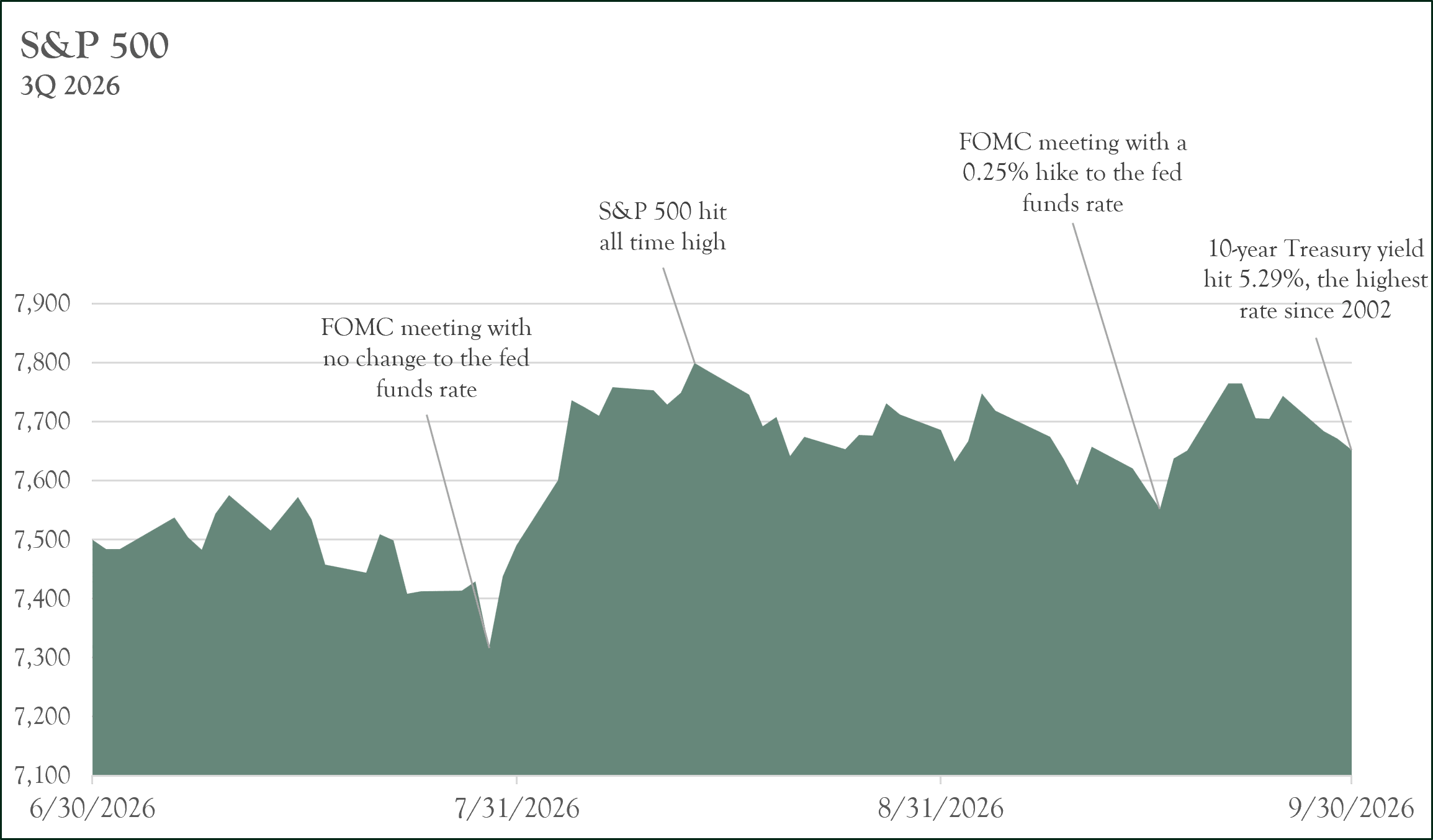
What drove the stock market?
“What’s Changed?” is a simple explanation of what happened in S&P 500 during the most recent period but does not necessarily explain why the market moved. Let’s explore the “why” by looking at three individual components that shape market changes.


Dividend Yield: The most stable of the three factors. Dividend yields were approximately +0.3% this quarter.
Change in Earnings Expectations: This quarter, earnings expectations for the next 12 months were strong, rising by roughly +7%. Similar to recent quarters, SI capital spending continues to be exceptionally strong, however, this quarter appeared to be more concentrated in the larger cap companies as evidenced by earnings growth expectations in the capitalization weighted S&P 500 (which is skewed towards very large companies, notably large technology companies) compared to earnings growth expectations in the equal-weighted S&P 500 index (which is skewed towards smaller companies in the large cap universe).
Change in Valuation: While economic expectations brightened during the quarter, investor sentiment toward valuations went the other way. The Price/Earnings ratio, a valuation indicator, fell from 20 times at the start of the quarter to 19 times at the end, a decrease of roughly -5%. We welcome a lower valuation ratio because high valuations leave less room for upside, but lower valuations can be a sign that investors are becoming more skeptical of the market. We believe that heightened skepticism reflects the continued uncertainty of the Iran war, looming mid-term elections (and the unknowns that brings) and the potential that earnings growth will slow.
What drove the bond market?
The bond market exhibited significantly higher rates during the quarter. The 2-year Treasury Note, which moved higher by 0.71%, closed the quarter at 4.88%. The 10-Year Treasury yield also increased, closing at 5.29%; a 0.82% increase.
With inflation persistently above target and employment data remaining strong, the Federal Open Market Committee (FOMC) tightened monetary policy by raising the federal funds rate by 0.25%, the first interest rate hike since July 2023. The market must now determine the cadence of further Fed actions, if any.
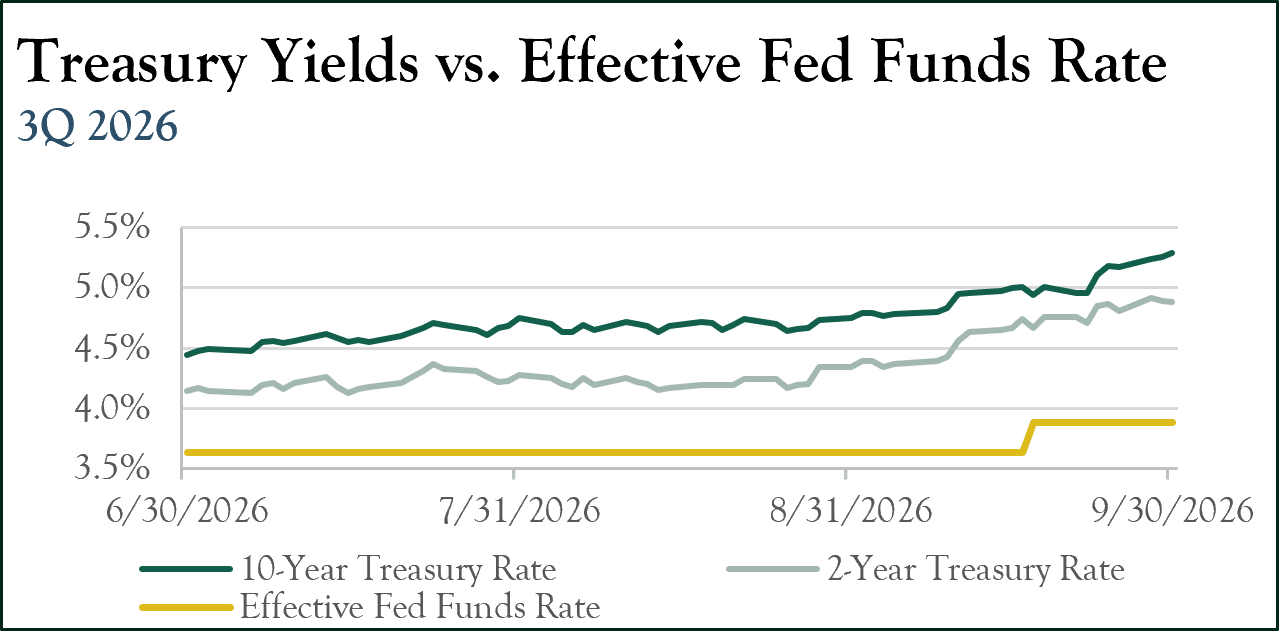
The rate of the 2-year Treasury Bill set by the market moved higher by 32 basis points to close the quarter, near 3.80%; while the 10-year Treasury Note closed the quarter at 4.32%, higher than 4.17% at year end. The market is coping with rising short-term inflation expectations and renewed concerns over government debt which is having a negative impact on prospective homeowners as 30-year mortgage rates have been rising (mortgage rates are often based on the 10-year Treasury rates).
Outlook
Effective investment management is as much about managing risk as it is about generating returns. However, controlling risk and matching risk exposure to individual client objectives is often under-appreciated in comparison to absolute and relative performance metrics. While risk is often associated solely with the possibility of loss, it also includes the opportunity cost of being underinvested or improperly positioned. In today’s environment, several important and, in some cases, competing risks must be managed for successful outcomes.
The S&P 500 reigns as the index of choice when benchmarking U.S. equity returns. While an index of 500 stocks allocated according to their market capitalization sounds like a diversified portfolio, its methodology favors the largest companies. When purchasing the index, investors are tacitly buying the largest companies because they are the largest companies. As a result, the top ten holdings now account for roughly 40% of the index and worse, are inter-related, if not in the same business. Diversification is about owning more than the largest companies in the world, even if they are the best performing assets of today. Broadening exposure and looking to underappreciated and/or overlooked areas of the market can reduce volatility (risk) of a portfolio (and potentially even lead to outperformance).
Interest rates represent a major consideration for multi-asset portfolios. Rates influence how companies finance their operations, pensioners pay their bills, and how investors value their equities. The reason for the recent increase in yields is largely unknown; however, we see several possible implications for portfolios. A more constructive interpretation is that investors expect stronger economic growth and productivity. Higher growth translates to investors demanding higher compensation for owning bonds – a welcome development for the savers of the world. A less favorable interpretation is that higher yields reflect concerns about government debt and deficit. These concerns could lead to fears over the credit worthiness of the U.S. government and put upward pressure on yields. Unfortunately, the investment decision for either of these scenarios differs considerably. A more growthy environment could support corporate earnings and equity returns, while fiscal and inflation concerns could weigh on stocks and adversely affect the bond market. Because it is difficult to determine which force will ultimately prevail, actively managing fixed income positions to take advantage of the yield environment and being nimble enough to move in and out of equities should enhance the portfolio’s risk-return profile.
Simmering tensions around the world have a way of falling off the front-page. Geopolitical risk, however, should remain top-of-mind for investors. Among the most significant risks to the market is the stress caused by oil supply, but the price of diesel fuel is the story to keep above the fold. Diesel is an important input throughout the global economy but especially meaningful in smaller, more cyclical parts like transportation, industrials and agriculture. While we think we know what will happen to these companies (and their stock prices) if the Strait of Hormuz remains closed, oil refining assets are continually damaged, and economies around the world teeter, we must also analyze the possibility of oil prices falling. It may seem a fanciful statement given the state of the Middle East or Russia/Ukraine, but in the short-term, we are looking for a de-escalatory push from this administration, especially before a mid-term election. If or when that happens, could the energy headwind transition to a tailwind? The potential benefits to corporate profits and inflation expectations are hard to ignore. For these reasons, it underscores the importance of avoiding portfolios built around a single outcome.
We have taken opportunities to build resilience into our portfolios to match the two-sided risks we see. Aside from broadening our equity positions, we want to remind our clients that their portfolios have been positioned for the potential of rising rates (though, in the most recent period, rates rose faster than almost anyone could have predicted). And this positioning outperformed relative to the broader bond market. However, like any investment, we must weigh the risk and reward based on future expectations. While we don’t know where the rate environment will ultimately settle out, this is not the time to abandon fixed income. Bonds now offer a more meaningful substitute for stocks than at any point in the past 20 years. There is an alternative! In today’s market, fixed income isn’t just a stabilizer, it can, once again, be a meaningful income generator for your portfolio. The transition to higher rates has been painful, but the resulting income opportunity is increasingly attractive for long-term investors.
Outside of traditional stocks and bonds, we believe alternative assets also belong in balanced portfolios. Combining assets that have a low correlation (or weak relationship) with other assets in a portfolio can improve diversification and lower risk without sacrificing expected return. This year, in a volatile market, uncorrelated assets like commodities have performed well. In fact, commodities are the best performing asset class year-to-date. In addition to oil, industrial metals like copper and agricultural soft commodities like corn or wheat have had significant moves despite the rise in rates or performance of the equities market. These select strategies provide additional diversification benefits through return streams that are less dependent on traditional stock and bond market direction.
Whether navigating geopolitical uncertainty, higher interest rates, equity market concentration, or changing inflation expectations, our objective remains the same: to construct diversified portfolios designed to participate in long-term opportunities while managing risk in a disciplined manner.
Sincerely,
Your Oarsman Capital Team