
1Q 2026 Review and Outlook
Equity markets were volatile in the first quarter of 2026 as investors navigated renewed geopolitical tensions, rising inflation expectations, private credit fears and a meltdown in software stocks. After three consecutive years of strong gains, the S&P 500 declined 4.3% during the quarter, reflecting a period of consolidation rather than a shift in long‑term market fundamentals.
Market performance varied widely by sector. Energy stocks were the clear leader as higher oil prices lifted the group. Utilities and Consumer Staples also performed well amid a renewed focus on perceived safety. In contrast, sectors that had driven gains in recent years, particularly Technology and Consumer Discretionary, lagged as investors rotated toward more defensive areas of the market.
International equities outpaced U.S. stocks, with both developed and emerging markets posting gains during the quarter. Smaller and mid‑size U.S. companies also held up relatively well, benefiting from a broadening of market leadership beyond large‑cap growth stocks.
In fixed income, bond markets were volatile as interest‑rate expectations shifted, leaving returns roughly flat overall. Real assets provided diversification benefits, with gold rising during the quarter and other commodities, led by energy, posting strong gains.
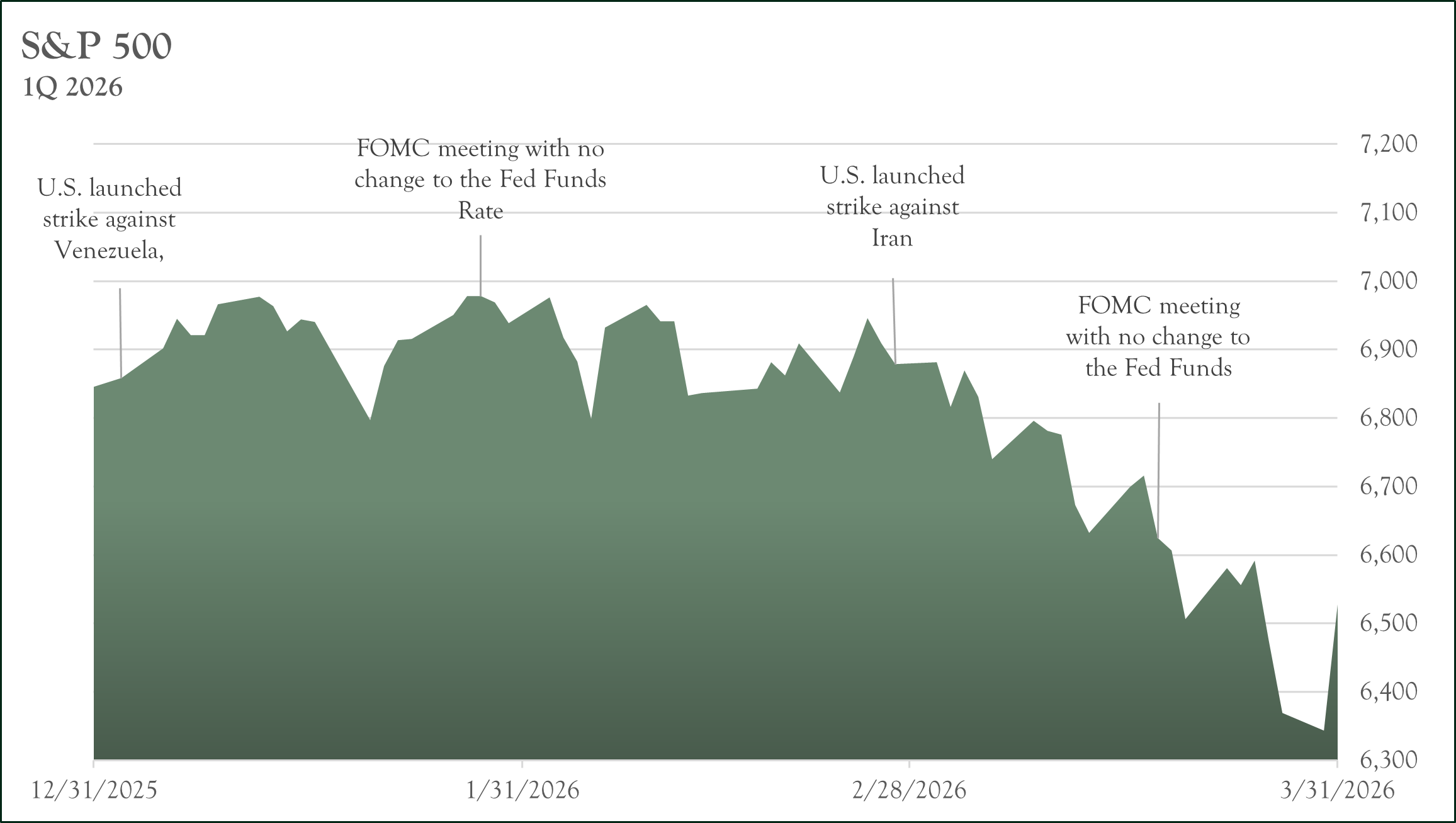
What drove the stock market?
“What’s Changed?” is a simple explanation of what happened in S&P 500 during the most recent period but does not necessarily explain why the market moved. Let’s explore the “why” by looking at three individual components that shape market changes.


Dividend Yield: The most stable of the three factors as corporations resist cutting their dividend except in the most extreme cases. Dividend yields were approximately +0.3% this quarter.
Change in Earnings Expectations: Over the long term, earnings drive stock prices. This quarter, earnings expectations for the next 12 months were exceptionally strong, rising by +8.0%. The artificial intelligence (AI) capital investment spending boom continues to spread across the economy into various sectors and helped drive upward revisions in earnings. Tax refunds were also helping to bolster anticipated earnings, though we would expect to see that tempered by the recent rise in gas prices.
Change in Valuation: The strong earnings growth expectations in the first quarter (normally linked to an also positive perception of value in the market) differed wildly from the change in valuation, which was sharply negative as we absorbed the nearly simultaneous headlines of war in Iran, concerns in the private debt market and whether AI would damage certain software businesses. The P/E ratio responded quickly to the bad news, compressing -12.6%. We anticipate that while war concerns will subside if the Strait of Hormuz opens for oil shipments, we will still be questioning the strength of the private debt market. At 19.3 times earnings, we believe the market is now more adequately pricing in potential risks than at any point in the past 12 months.
What drove the bond market?
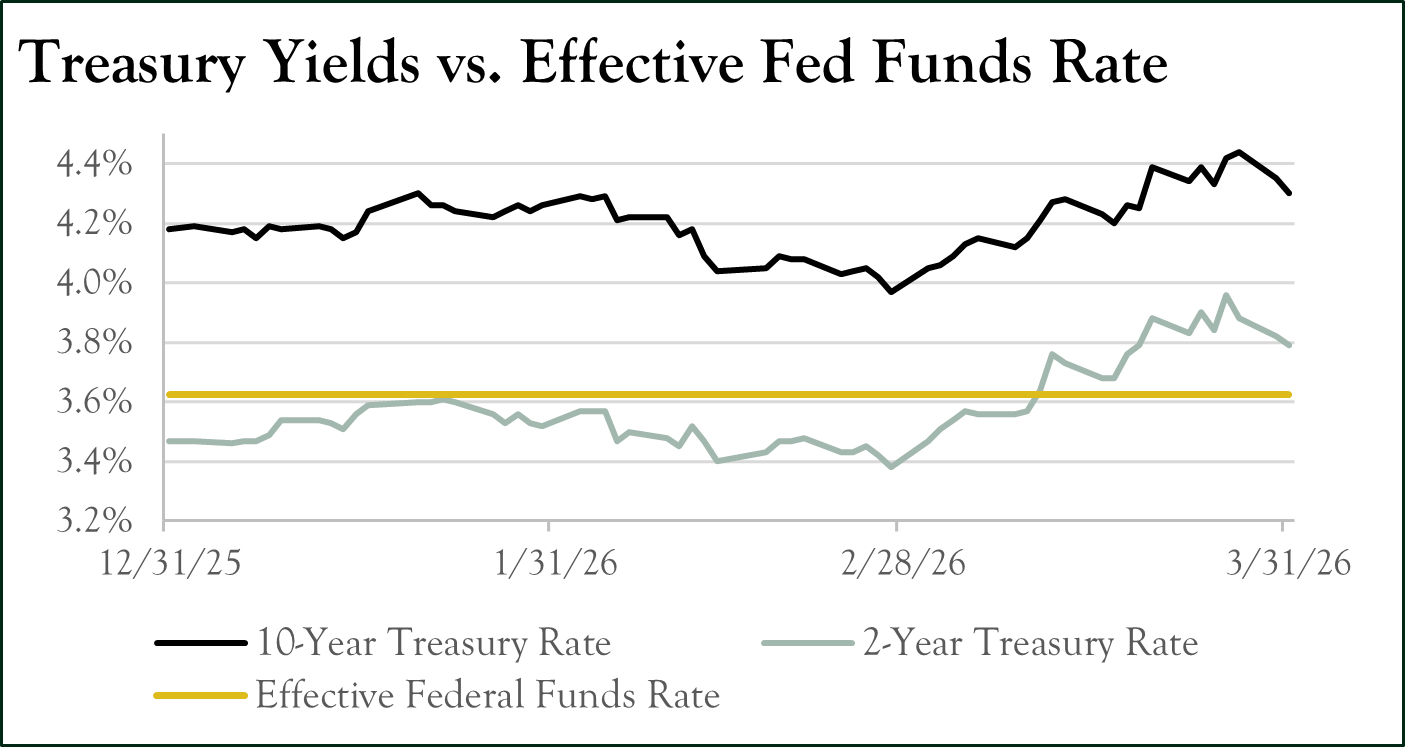
The Federal Open Market Committee (“FOMC”) held two meetings in the first quarter and made no changes to the Federal Funds Rate range of 3.50% to 3.75%. With shorter-term inflation expectations rising, the Fed has opted for a wait-and-see approach. A stronger-than-expected labor market is also supporting the pause. Fortunately for the Fed, longer-term inflation expectations seem anchored near 2.5%, indicating no immediate action required.
The rate of the 2-year Treasury Bill set by the market moved higher by 32 basis points to close the quarter, near 3.80%; while the 10-year Treasury Note closed the quarter at 4.32%, higher than 4.17% at year end. The market is coping with rising short-term inflation expectations and renewed concerns over government debt which is having a negative impact on prospective homeowners as 30-year mortgage rates have been rising (mortgage rates are often based on the 10-year Treasury rates).
The rate of the 2-year Treasury Bill set by the market moved higher by 32 basis points to close the quarter, near 3.80%; while the 10-year Treasury Note closed the quarter at 4.32%, higher than 4.17% at year end. The market is coping with rising short-term inflation expectations and renewed concerns over government debt which is having a negative impact on prospective homeowners as 30-year mortgage rates have been rising (mortgage rates are often based on the 10-year Treasury rates).
Outlook
Recent months have reminded investors how quickly markets can be shaped by evolving headlines and global events. While uncertainty has been elevated, it is useful to step back, tune out the noise, and re-examine the underlying trends in place prior to the events of late-February.
To begin, changes to tax laws from the OBBBA has incentivized companies to build and/or re-shore manufacturing processes in the United States. These capital investments are made through a multi-year lens and short-term gyrations in the market will not change these decisions. March Manufacturing PMI® provided by the Institute of Supply Management was reported at 52.7%, it’s the third consecutive month in expansion territory, inferring economic health in important areas of the U.S. economy.
Secondly, artificial intelligence (AI) is believed to be seminal technology, and many think we are only in the early stages. This is a key topic of conversation in nearly every boardroom or C-suite across the corporate world. Everyone from the largest of companies investing tens of billions of dollars annually on infrastructure capital expenditures to the sole proprietor experimenting with its potential uses, has an incentive to monetize this technology. There will be winners and losers in this reallocation of capital but the opportunities for both creators and users could be widespread and impactful. The early build-out is largely a U.S. phenomenon, with semiconductor and hyper-scalers driving the early implementation but improvements in worker productivity are just beginning to trickle down to smaller entities and move abroad.
Lastly, U.S. employment remains quite strong. March payrolls were up 178,000 month-over-month with gains in manufacturing and construction; while the unemployment rate also appears rangebound near 4.3%, and below long-term averages. Several high‑profile layoffs were announced during the quarter, but strong corporate profitability should continue to support employment levels and, by extension, consumer spending. Taken together, these factors provide a constructive backdrop for sustained earnings growth of U.S. corporations.
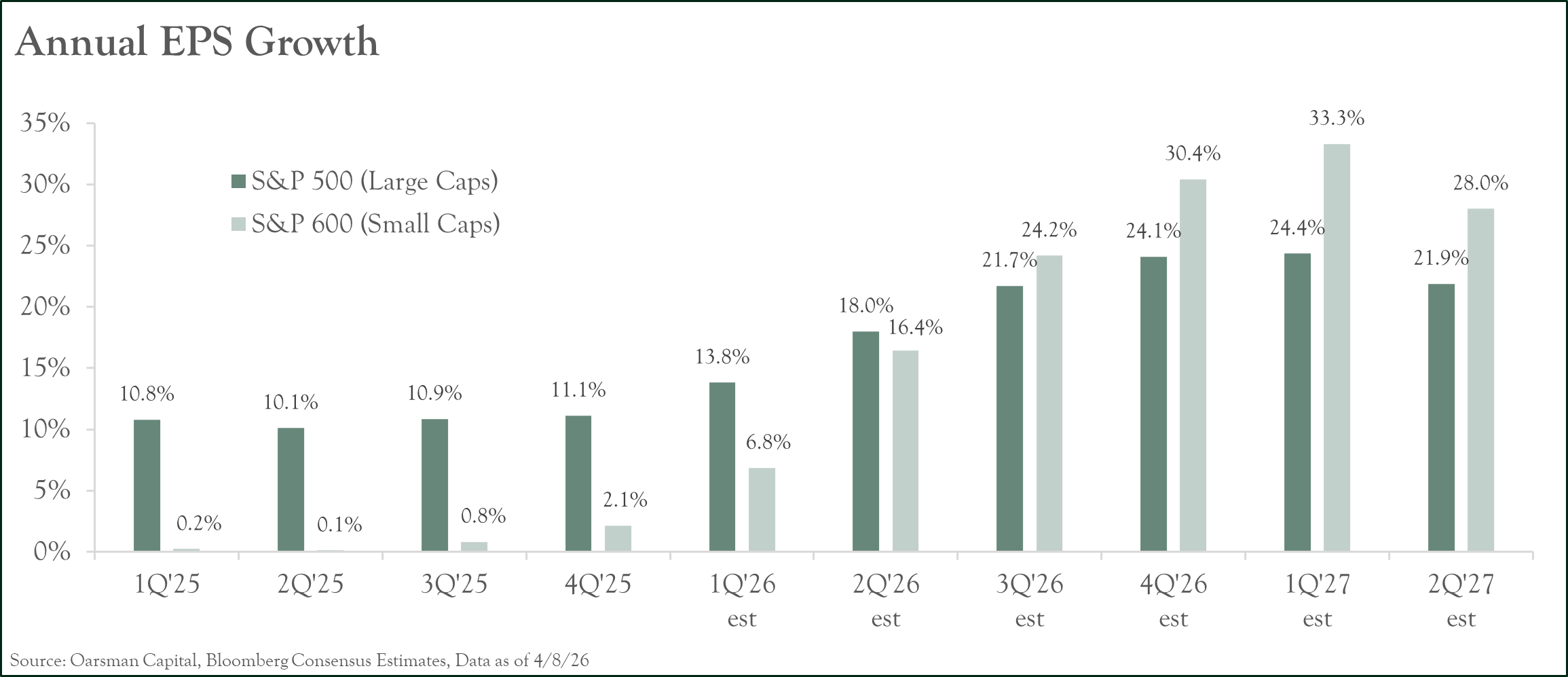
Despite the daily headlines, corporate earnings estimates continue to show growth in the coming quarters. And herein lies the paradox of this market: Are earnings estimates too optimistic and must be revised downward (given the current conflict) or are analysts correct in looking through short-term events to the ultimate earnings power of corporations? History suggests that markets often struggle to price uncertainty in real time, particularly when risks are difficult to quantify. While exogenous shocks can temporarily weigh on confidence and valuations, corporate adaptability, cost discipline, and secular growth drivers have frequently proven more resilient than initially feared. Only time will tell but we will be searching for clues in earnings calls that kick off later this month.
While we believe the longer‑term structural outlook for the U.S. economy remains intact, the near‑term environment has undoubtedly become more complex. In the aftermath of the Covid pandemic and the global supply‑chain disruptions that followed, inflation had been moving gradually lower, a process that proved longer and more uneven than many anticipated, but one that was nonetheless trending in the right direction. More recently, however, a renewed wave of tariff actions and escalations in the Middle East have reintroduced upward pressure on prices across the global economy. Energy markets, in particular, warrant close scrutiny. Oil and natural gas serve as foundational inputs for transportation, manufacturing, agriculture, and a wide range of services, making energy costs a critical transmission mechanism for inflation. Rising gasoline prices can quickly weigh on consumer confidence and discretionary spending, acting as a drag on economic momentum and increasing the risk of demand destruction. For central banks, this dynamic presents a particularly challenging scenario. Growth may slow even as inflationary pressures reemerge, complicating the path forward for monetary policy. The longer these disruptions persist, the greater the risk that higher costs become embedded, tightening financial conditions and potentially degrading the long-term outlook.
International markets have exhibited meaningful weakness over the past month, reflecting heightened sensitivity to global macro and geopolitical pressures. Unlike the United States, however, these economies are far more exposed to energy supply risks, with a significant portion of their oil consumption transiting through the Strait of Hormuz. This reliance increases vulnerability to supply disruptions and price volatility at a time when geopolitical tensions remain elevated. As energy costs rise, the impact tends to be more acute, weighing on growth, inflation, and currency stability. Access to reliable and affordable energy remains a fundamental prerequisite for economic security, and prolonged uncertainty in this area continues to challenge the outlook for many international markets. Until these issues can be resolved, we will remain structurally underweight international equities in our portfolios.
It is remarkable how three months can simultaneously feel like both a very long and very short period of time. In our previous letter, geo-political risk was acknowledged but had no mention of Iran hostilities. Now nearly six weeks of war and it already feels uncomfortably long. The unfortunate stars during this period were commodities and energy stocks – notably underperformers during previous quarters. It does serve as a good reminder of the risks associated with a portfolio of highly correlated assets – something we work to avoid. When sentiment turns negative, proper risk management through a diversified portfolio of stocks, bonds, cash, and alternative assets shows its value.
Sincerely,
Your Oarsman Capital Team